The F Word
Some history on the word that's been on all of our lips.

It is a self-evident cliché of political discourse that letting accusations like fascist, racist, or Nazi fly too loosely “weakens their power when you actually need them.” But the experience of the past decade seems to me to establish the possibility that this cliché itself is central to how these words have lost their power. When it is reiterated time and again that the word fascist operates as nothing other than an empty slur, that interpretation comes to override all of its original content. Godwin's law—which warns against the inevitability of the Reductio ad Hitlerum in online arguments—ironically establishes the criteria that the comparison to fascism is always inherently an exaggeration. The pithy form of this, which says that “the first participant in an argument to invoke Hitler loses the argument,” captures the problem perfectly; the symbolic position of Hitler in politics today is as a purely hypothetical instrument of debate, and not as the very concretely real reichskanzler and dictator of Nazi Germany from 1933 to 1945.
One problem with attempting to rescue the word fascist from this trap is reckoning with the quite factual basis for Godwin’s law in the word’s regular abuse. Even as early as 1944, while the Nazi Wehrmacht was still occupying parts of Europe, George Orwell was able to lament that “as used, the word ‘Fascism’ is almost entirely meaningless,” and that “almost any English person would accept ‘bully’ as a synonym for ‘Fascist’.” Our first predicament is that fascism never really just means fascism—as in, nothing so limited as the Fasci of Italian street politics who eventually formed the bedrock of Benito Mussolini’s Partito Nazionale Fascista. Fascism is a montage of images such that the whole 20th century flashes by in the mind’s eye. It associates and analogises disparate events. Concepts agglomerate at the bottom of our cultural memory, like ideological cholesterol. Mussolini, Hitler, Franco, Stalin, FDR, Goldwater, LBJ, Nixon, Reagan, Bush. Is NATO fascist? What about the Council on Foreign Relations? Obama? (Are women bourgeois?)
These questions mean more in the asking than in the answering. The point is to suggest a single overriding explanation for the 20th century, and to thereby connect it to whatever happens next in our time. The problem is that distinctions matter. It might be obvious to the point of being tautological, but things are the same up until the point where they are different. There are very few cases that will match one-to-one with the discrete political movement that appeared in Italy in the early 20th century under the name “fascism.” Even current supporters of Hitler and Mussolini are most often called neo-nazis or neo-fascists, as opposed to their original name, in recognition of the simple fact that they now operate from within our own distinct post-war historical context. Therefore, the challenge for any applicable definition of fascism concerns which historical similarities or dissimilarities strike us as salient—and most importantly, the why that stands behind any of these determinations.
In its vulgar form, fascism just means anything that is both bad and right-wing. And from the vantage point of the left, where the right-wing is already a bad thing, it therefore follows that we can simplify this definition to say that fascism just means anything that is right-wing. This understanding of the word has the merit of being, as the kids say, based. But as an unmistakably shameless generalisation, it is only truly useful as a tool of rhetoric—not as any kind of intellectually consistent standard. Moreover, even on these crass terms, the strategic value of something which operates quite like the Stalinist theory of social fascism is at least open to some doubt, considering the fact that the Stalinists lost political power in all of the places where they tried it.
An interesting variant of this exercise has been attempted, where anything with the slightest whiff of authoritarianism tends to be labelled as fascist. This leads ironically to Stalinists themselves being tagged with the accusatory title of “red fascists.” Such horseshoe theories of fascism are even more extreme in their ability to mark everyone and anyone as fascists—resulting in what may be the most faithful definition of the word in terms of its wider discursive role: fascism means anyone who is opposed to my current politics. (Omega based?)
Every attempt to define fascism that depends on the method of listing a series of coincident elements is at risk of falling prey to this problem of generalisation. This is true even of the most comprehensive and laudable cases, such as the criteria laid out by Umberto Eco in his famous essay Ur-Fascism. While it is historically accurate to say that the regimes which have generally been called fascist share a number of the features highlighted by Eco—middle-class anxieties, anti-pacifism, worship of the masculine—this methodology does not do nearly enough to justify its own inclusivity. That is, while such a list has its pragmatic uses, it nonetheless begs the question of why we would want to utilise the concept of fascism at this precise level of specificity in the first place. It captures key points of comparison between historically fascist governments—namely between the Italians and the Nazis. But so long as it does not speak to a theoretical basis for fascism, it fails to demonstrate a reason to structure our understanding of these particular states so rigidly around these points of overlap.
The most obvious left-wing answer to these theoretical problems can be found via the Marxian techniques of class analysis and historical materialism—which together supply an abundance of whys behind every social is. And to be sure, as we will amply see as we continue our discussion, there is no path to a satisfactory definition of fascism that does not pass through its class composition and a historically materialist analysis of its foundations. Yet, we have already seen the dangers that follow from certain applications of this methodology—as in the theory of social fascism discussed above.
According to the Stalinist vision of history, the contents of a political movement are retroactively determined by its final impact on the class war. Therefore, the class relations that allowed for the victory of fascism from within bourgeois democracy transfigured bourgeois democracy into per se fascism from the beginning. This is the same essential claim that is advanced by Stalin’s famous dictum that “Social-Democracy is objectively the moderate wing of fascism.” Refuting the whole Stalinist metaphysic is beyond my interest for today. But the immediate problem with this reduction is its plain circularity. Even supposing that the final terminus of ‘capitalist barbarism’ is a phenomenon called fascism, delineating the boundaries of that phenomenon by nothing other than its roots in capitalism is just to repeat the supposition as the definition. In other words, it leaves the word fascism with no particular content. A fascist is simply anyone who fails to achieve communism—willingly or otherwise.
Whether or not this definition is correct, it is at a minimum not useful; in truth, the only use it was ever meant to serve was enlarging the position of the Communist Party of the Soviet Union. A useful definition of fascism has two clear tasks: it must communicate a causal-theoretical basis for the concept to be specified in the first place, and it must relate this basis to a concrete political phenomenon which can be distinguished in appearance from that which is discretely not fascism.
Despite the evident barriers to a good definition of fascism, its historical origins have been largely demystified. In the early 1950s, when Aimé Césaire and Hannah Arendt attributed Nazism to an “imperial boomerang.” they did not even have access to our own abundant historical record of the colonial crimes that prefigured the Holocaust—especially those contained in the 1985 Whitaker Report. But what they did know was damning enough: That the SA and SS based their uniforms and paramilitary organisation on the Schutztruppe colonial police force, and that high ranking Nazis spoke of the policy of lebensraum in precisely colonial terms, with Hitler even saying that “the Russian space is our India.”1 The hypothesis that fascism has its decisive conceptual roots in the project of European colonialism is one that only becomes harder to refute as we learn more about the nature of that project. In this light, we can point to the boomerang theory as our first defining element of fascism: fascism is, as Arendt argued, a reintegration of the colonial ideologies of line-drawing and military policing into the nationalist politics of the colonial homeland.
But this first step only gets us so far. While the pan-nation movements that metastasised into fascism proper were undoubtedly colonialist ideologies, the political justification for fascism also clearly extended past mere colonialism. Fascism only appeared as itself in correspondence with a wider array of the political forces of the early 20th century.
Vladimir Lenin famously referred to the interdependent structures of domestic capitalism and global colonialism as imperialism—or, ”the Highest Stage of Capitalism.”2 The Stalinist theory of social fascism was at least nominally an extension of this imperialism theory, in that it saw the capitalist societies that conducted the First World War and the fascists who came to drive the Second as being made of the same ‘imperialist’ essence. But this would only be true if fascism was nothing other than the ‘true’ face of 19th century capitalist imperialism returning to the homefront. While the imperial boomerang is quite rightly the beginning of what became fascism, a quick survey of actual fascist politics brings the lie to this notion of a simple equivalence.
Fascism extends far beyond the brutal and naked racism of the colonial frontier. Fascism is also a conspiracy theory about the nature of race and the nation-state, and their combined relationship to the overall validity of politics. A fascist does not just think that ‘other races’ are lower than their own as a vulgar biological ‘fact’, they also believe that a race war is the secret index to all of world history. According to this doctrine, the politics and economics of the nation-state, which is the dominant unit of organisation in modern history, is just a façade that covers over the real politics of racial civilisations which determine actual history. If the political superstructure does not cohere to the needs of the racial nation, this is only proof of the corruption of politics by ‘alien races’.
This is the juncture where it becomes evident that the prevalence of antisemitism in fascist politics is something quite different from a strange quirk or unhappy historical coincidence—and that the efforts in recent years to interpret Jew hatred as a “non-exceptional” bigotry are misguided. Antisemitism, of course, exhibits forms of hatred and disgust as base as any other prejudice. But it is also a noxious theory of the world. To be an antisemite is to hold an inviolable contempt for the anti-national character of Jewishness. In order for a racist to explain the continued survival of an ancient and homeless people, a narrative of conspiracies, cabals, and secret international politics must always follow. Antisemitism and the racial conspiracism of the fascist overlap so perfectly as to be functionally indistinct. It is impossible to interpret world history as the interoperation of racial nations without identifying Jews as an eradicable surplus element in every polity where they exist.
It is unsurprising that antisemitism was already a pervasive social trend in the empires that conducted the First World War—and who subsequently fell prey to the fascist phenomenon. It is therefore quite right to see the kind of imperialism identified by Lenin as the egg from which fascism hatched in the 20th century’s decades of crisis. However, in order to express the distinction between these incubatory conditions and fascism proper, we should briefly formulate the class-based theory of fascism in a manner distinct from its vulgar identification with capitalist imperialism. This will have the additional benefit of further emphasising that fascism is a distinct subspecies of crisis within capitalism, rather than capitalism’s ‘true face’ as is often maintained.
The most famous anti-Stalinist variation on the imperialism theory came from Leon Trotsky. According to Trotsky:
The bonfires which burn the impious literature of Marxism light up brilliantly the class nature of National Socialism. While the Nazis acted as a party and not as a state power, they did not quite find an approach to the working class. On the other side, the big bourgeoisie, even those who supported Hitler with money, did not consider his party theirs. The national “renaissance” leaned wholly upon the middle classes, the most backward part of the nation, the heavy ballast of history. Political art consisted in fusing the petty bourgeoisie into oneness through its common hostility to the proletariat. What must be done in order to improve things? First of all, throttle those who are underneath. Impotent before big capital, the petty bourgeoisie hopes in the future to regain its social dignity through the ruin of the workers.3
In contrast to the top-down reactionary programmes characteristic of pre-democratic eras—and in a further distinction to the role of big business in capitalism proper—fascism was a mass movement of the deracinated and resentful elements of the middle-class who reacted most strongly to the political and economic instability of the inter-war years. Some video essayists have made the case in these terms:
But what is the transmission point between these class resentments and the conspiratorial racial politics of fascism? In a stunningly under-discussed portion of her imperial boomerang thesis, Hannah Arendt suggests that the alienated and atomised middle-class space between the working- and capitalist classes, from which fascism drew its popular base of support, reached the ideology of racism precisely through their economic relationship to the imperialist gambit.
Nationalism, defined as the inward facing belief in the legitimacy of the nation, was intrinsic to the structure of sovereign nation-states that arose through the bourgeois revolutions of the 19th century and their adherence to political Romanticism. But imperialism, defined as the outward facing ideology of expansion and accumulation, was a contrary system that arrived at the end of that same century and modified the basic self-understanding of these political units. This separation, however, was short-lived; “in theory, there is an abyss between nationalism and imperialism; in practice, it can and has been bridged by tribal nationalism and outright racism.”4 Racism was a necessary reactant for the synthesis of the nominally opposed forces of nationalism and imperialism.
The European middle-class was highly sensitive to the push and pull of these two forces. They were attached at the hip to the parochial interests of the nation, but nonetheless aspired to the accumulation and expansion of the imperialist bourgeoisie. By contrast, the purely imperialist elements of the bourgeoisie were comparatively international in outlook and entirely centred on the extractive utility of economic expansion. As Arendt explains, it was racism as a political ideology—as distinguished from racial prejudice more generally—that brought a certain portion of these alienated classes into a common stance alongside the bourgeoisie: “Race society taught the mob the great lesson of which it had always had a confused premonition, that through sheer violence an underprivileged group could create a class lower than itself, that for this purpose it did not even need a revolution but could band together with groups of the ruling classes, and that foreign or backward peoples offered the best opportunities for such tactics.”5 That is, the same basic lesson of fascism which was identified by Trotsky: “What must be done in order to improve things? First of all, throttle those who are underneath.”
The reason that a new concept of the nation, known as the racial nation, arose in order to reconcile itself to the seemingly opposed capitalist project of imperial expansion was because the nation and capitalism were in fact interdependent from the beginning. The central theorist of this structure is Koujin Karatani, who explains that:
In his famous book, Imagined Communities, Benedict Anderson said that the nation-state is a marriage between nation and state that were originally different in kind. This was certainly an important suggestion. Yet it should not be forgotten that there was another marriage between two entities that were totally heterogeneous—the marriage between state and capital. … States were based upon the principle of plunder and redistribution. The agrarian communities that were mutually disconnected and isolated were dominated by states; but, within themselves, they were autonomous, based upon the principle of mutual aid and reciprocal exchange. Between these communities, markets or cities grew; these were based upon monetary exchange relying on mutual consent. What crumbled the feudal system was the total osmosis of the capitalist market economy. But the economic process was realized only in the political form, of the absolutist monarchy. The absolutist monarchical states conspired with the merchant class, monopolized the means of violence by toppling feudal lords (aristocracy), and finally abolished feudal domination (extra-economic domination) entirely. This was the very story of the wedding between state and capital. Protected by the absolutist state, merchant capital (bourgeoisie) grew up and nurtured the identity of the nation for the sake of creating a unified market. Yet this was not all in terms of the formation of the nation. The agrarian communities, that were decomposed along with the permeation of the market economy and by the urbanized culture of enlightenment, had always existed on the foundation of the nation. While individual agrarian communities that had been autarkic and autonomous were decomposed by the osmosis of money, their communalities—mutual aid and reciprocity—themselves were recovered imaginarily within the nation.6
In the most basic terms, the materialist history of the First World War begins with one corner of this triad—capital—coming to dominate the rest of the nation-state structure for its own benefit. This imbalance took the form of a phenomenon known as imperialism. However, since capital depends upon nation and state, the politics of nationhood—the applied meaning of the nation-state—shifted and reconciled itself to the reality of outward facing imperialist antagonism between nations. This crystallised in the concept of a race war between racial nations. That is, imperialism for the sake of what the Nazis called the volksgemeinschaft.
It is important to understand that this reconciliation was itself two-way. Imperialism, which was originally conducted for the sake of the accumulation of capital by internationalist bourgeoisie, itself transformed to become an integrated organ of the capital-nation-state of the volksgemeinschaft. This is exactly why the collapse of imperialism brought on by the First World War ‘boomeranged’ back into Europe in the form of a civil war between the old liberal internationalist bourgeois democrats and the new nationalist bourgeoisie of the volksgemeinschaft—that is, in the latter case, fascists.
The above functions well enough as a heavily abbreviated history of the origins of fascism, and in the course of that endeavour it does hint at several of its key tenants as an applied ideology. But no fascist—conscious or otherwise—understands their own political disposition in terms of these historical origins. As Arendt says, “no man, it has turned out, can live among ‘causes’.”7 Fascists believe that the race war is eternal; race as such becomes the true origin of all other political concepts, including capitalism and the state. They therefore do not think of their own politics as subject to these forms of historical determination in the first place. They simply believe they are speaking the plain common sense truth of race as it appears in the objective world. To reach a useful conclusion, we will have to reckon with the problem of speaking of fascism as a phenomenon that appears in the domain of consciously held political opinion.
It is of course obvious that fascism is defined by its racism. But the widely held notion that fascism entails a singular, specific theory of race is misguided. Fascism historically operated under a ‘big tent’ concept of racism, where the biological justifications for racism popular with Social Darwinists and eugenicists co-existed with a wider range of esoteric racisms. Consider the example of Alfred Rosenberg, an official spokesman for the Nazi regime who traced the lineage of the German people to the mythic land of Atlantis—in a manner more reminiscent of Ancient Aliens than the popular image of Nazi race science. Heinrich Himmler believed that the German race had its origins in the magical properties of earth spirits. Julius Evola posited that race dwells in the soul, and that fascism’s proper historical role was the fulfilment of Hindu prophecy. It is generally impossible to limit fascism to one species of justification for racism, or even one definition of what race means.
The crucial point about this ideological flexibility is that it stands in sharp distinction to the generally held assumption that fascism is always synonymous with conscious support of Adolf Hitler’s specific racial prejudices or his theories of racial history. There was no such consensus even in the highest ranks of the Nazi party, let alone among the broader incarnations of fascism across the globe. This presents an obvious problem: if we cannot rely on Hitler of all people to function as our guidepost for fascist ideology, the word is at risk of shrinking back into the mists of obfuscation and hyperbole. However, some slight equivocation on this point is exactly what we are aiming at. The sheer scale of Hitler in the collective memory is so imposing that it has become commonplace to mistake his opinions and tendencies with the wider political movement known as fascism, which he was a mere agent of. And Hitler was, as far as the ranks of fascism went, a remarkably unimpressive intellect: “Hitler stood out only because of his big temperament, a voice much louder than others, and an intellectual mediocrity much more self-assured.”8 The challenge lies in locating the characteristic symptoms of fascism as a political disease without reducing our analysis to just the afflictions of its most conspicuous patient.
The accumulation of many different racisms under the banner of fascism is an important feature of its political structure exactly because a certain fluidity to the concept of the alien enemy is essential to the kind of social control that the fascist seeks. On this point, it is interesting that so many intellectuals who had no interest in the subject of race at all, such as Carl Schmitt, enthusiastically signed up to be Nazis. For those in the Schmittian camp, the point of Nazi politics was not the racism per se. It was that the racial nation was the only form of the capital-nation-state structure that seemed to be able to adequately oppose both democracy and international socialism. In contrast to aristocracy and other antiquated forms of reactionary politics, fascism offers the capacity to channel the democratic notion of popular sovereignty into a mass movement that would nonetheless vest ultimate sovereignty in a single party and a single leader—on behalf of the ‘spirit’ of the nation. This leads to an important distinction: fascism is entirely comfortable making use of support for the political structures of racism where it cannot rely on a conscious ideology of racism.
If there is one core belief of fascism, it is not mere naked racism, but rather the centralisation and homogenisation of the capital-nation-state structure such that its three pillars appear indistinct. This entails the racial nation concept because it is the only form of politics that perfectly segments every relationship into the categories of insider and outsider. In the case of Nazi Germany, for example, outward-facing imperialist expansion by capital becomes the basis for the accumulation of capital by Aryans: the extermination of one part of the national community becomes the purification of Aryan civilisation: the totalitarian methods deployed by the state transform into the collective security of all Aryans. The meaning of race in this context is shockingly flexible; what matters is that it serves the core aim of bringing about a unit of collectivity by which the ‘people’ can participate in the imperialist aims of expansion and accumulation. Fascism is therefore an ideology that allows anyone who stands against this centralisation to be exiled and placed in the position of the outsider, and the outsider is then subjected to the ideology of racism as it came to be understood through the project of European colonialism. In other words, fascism is the complex structure by which the nation-state instrumentalises racism in order to imperialise anyone it needs to, including itself; it is colonial racism returning home in the form of a death cult.
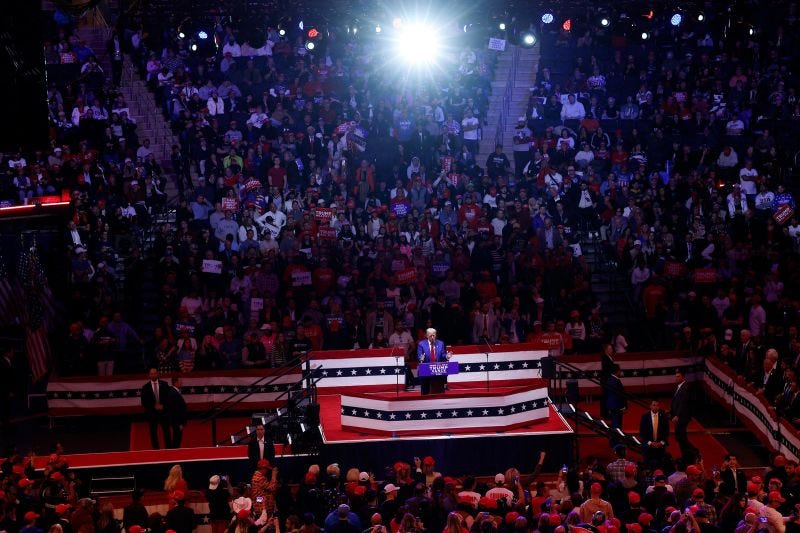
The obvious weakness of this definition is that it does not provide enough criteria to easily identify individual political actors as essentially fascist. The subtext of this concern is, unsurprisingly, a matter of whether or not it justifies the use of the word fascist when discussing the current Trump administration. In our present moment, every semantic concern about the word fascist is necessarily related to litigating the danger posed by Trumpism. The problem is that Trumpism, which in its broadest possible definition encompasses almost half of the American electorate, includes a great number of people who do not consider themselves to be fascists in any psychological sense. Indeed, we can more or less take it as a given that only a very limited proportion of Trumpists think of themselves as anything less than anti-fascist and anti-racist.
But as we can see in the history of actually existing fascism, its power has always depended on the participation of a mass movement that is separate from the smaller core of committed ideological racists. Since fascism worships the power structures of racism in a sense that is not strictly limited to any shared theory of race, this division is not at all a sign of the political weakness or irrelevance of fascism. Fascism should first and foremost be thought of as a historical force that mobilises support for the structures of racism and assigns them independent value. There is of course a consciously racist segment of any fascist movement—represented by groups such as “Frogtwitter” and the “Groypers” today. But this historical force also depends on a distinct form of ideological moulding that takes place exclusively amongst the members of the mass movement.
Over the course of the opening three months of the second Trump administration, the United States Immigration and Customs Enforcement (ICE) agency has undertaken a startling series of operations following from the president’s promise of mass deportations. Many of these deportations have been attempted in defiance of the basic legal procedures of due process and habeas corpus. And in the case of the alleged deportation of “pro-Hamas terrorists,” there has been a clear attempt to broaden the purpose of these operations from mere illegal immigration to include ideological enemies of the administration. On the 15th April 2025, the president further said that these deportations should also grow to encompass “homegrown criminals”—that is, American citizens. The fascist nature of such a regime of denationalisation was easily recognised by Hannah Arendt, who said:
The first essential step on the road to total domination is to kill the juridical person in man. This was done, on the one hand, by putting certain categories of people outside the protection of the law and forcing at the same time, through the instrument of denationalization, the nontotalitarian world into recognition of lawlessness. … Denationalization became a powerful weapon of totalitarian politics, and the constitutional inability of European nation-states to guarantee human rights to those who had lost nationally guaranteed rights, made it possible for the persecuting governments to impose their standard of values even upon their opponents.9
A central confusion with any attempt to reduce fascism to just the most extreme forms of active racism and genocidal intent is that it loses sight of fascism’s continuous cooperation with cynicism and nihilism to achieve its political goals: “The loyalty of those who believe neither in ideological clichés nor in the infallibility of the Leader also has deeper, nontechnical reasons. What binds these men together is a firm and sincere belief in human omnipotence. Their moral cynicism, their belief that everything is permitted, rests on the solid conviction that everything is possible. It is true that these men, few in number, are not easily caught in their own specific lies and that they do not necessarily believe in racism or economics, in the conspiracy of the Jews or of Wall Street. Yet they too are deceived.”10
No one can draw a hard line as to where this moral cynicism transforms into active support for the fascist programme. But this ambiguity can quickly strip the word of all meaning if we let it. What we should instead do is identify the historical basis for fascism, and its symptomatic use of cynicism, racism, and juridical exile for the purpose of sustaining totalitarian state power, and make reasonable individual judgments about who is crossing the line into active cooperation with these forces. The word fascism can of course become an empty trope when these judgments are made too broadly; among the foot soldiers of fascism, there are a great many cases where “they too are deceived.” But ignorance is not reason enough to exonerate all of those who sleepwalk their way into the worst evils that humanity has ever invented. At the very least, we must reserve the moral right to call fascism by its name as it knocks on our door.
Dallin, Alexander. 1981. German Rule in Russia, 1941-1945 : A Study of Occupation Policies. Palgrave.
Arendt, Hannah. 1951. The Origins of Totalitarianism. Penguin Classics.
Ibid.
Karatani, Koujin. 2005. Transcritique. MIT Press.
Arendt, Hannah. The Life of the Mind. Harvest Books, 1981.
Arendt, Hannah. 1951. The Origins of Totalitarianism. Penguin Classics.
Ibid.